Future-Ready Utilities – Article 1
The Hidden Value of Inspection Data: Why Labeling Today Shapes the AI of Tomorrow
By Michael Kay, Chief AI Officer, Remote Intelligence Solutions
Why Everyone is Talking About AI
Artificial Intelligence, or AI, has become shorthand for progress. It promises faster decisions, predictive insights, and operations that seem to “run themselves.”
This article is the first in our Future-Ready Utilities series — a practical, step-by-step guide that will help utilities move from understanding what AI really is to building the data foundations for advanced concepts such as Continuous Supervised Learning, Unsupervised Insight Discovery, and AI-Enhanced Temporal Analysis.
At its core, AI is not magic; it is pattern recognition at scale. Computers learn patterns the same way people do: by seeing, labeling, and remembering. A child learns what a cat is by seeing many cats and hearing, “That’s a cat.” Machines learn in exactly that way through machine learning (ML); a branch of AI that extracts meaning from labeled examples.
In fact, most of us already use AI every day — more specifically, applied machine learning — without noticing it, when our email filters spam, when a phone camera automatically enhances a photo, or when a map predicts traffic and suggests the fastest route. What makes all these systems work is the same ingredient utilities can start building today: labeled data.
Without examples, without labeled data, there is no learning.
The Missing Ingredient: Data That Teaches
Digital transformation has given every industry mountains of data. Yet most of it is unusable for AI because raw data is just noise until someone explains what it means.
That explanation — the label — turns data into knowledge:
- A photo becomes valuable once it’s labeled “transformer – corrosion visible.”
- A waveform becomes meaningful when labeled “line fault – phase B.”
- A temperature reading gains context when linked to “asset #1045, bearing 1.”
Labeling tells a system what it’s looking at, allowing it to find similar patterns later.
AI, ML, and Labeling — In Plain Language
| Concept | What It Does | Depends On |
|---|---|---|
| Artificial Intelligence (AI) | Mimics human reasoning or decision-making | Machine Learning |
| Machine Learning (ML) | Learns patterns from examples to predict or classify | Labeled Data |
| Labeled Data | The examples — the “truth” used for learning | Human or system labeling |
If AI were an orchestra, machine learning would be the conductor, and labeled data would be the sheet music. Without written notes, even the most talented conductor can’t bring harmony from the players.
How CAPTCHA Helped Build Modern AI
You’ve likely seen those online puzzles that ask you to “Select all squares with traffic lights” or “Click every image that contains a bus.” Originally designed to block spam bots, these CAPTCHAs became one of the world’s largest data-labeling projects.
Every time someone identifies a bus, bridge, or storefront, they’re helping a machine learn what those objects look like. Billions of those human clicks quietly trained the AI systems behind autonomous vehicles, mapping software, and image search engines.
That’s machine learning in action: humans label examples, and over time the system recognizes those patterns automatically.
Utilities can do the same. Each labeled inspection image — “transformer,” “rust,” “cracked insulator” — teaches the algorithm what those conditions look like. A few consistent human decisions now will later allow AI to scan thousands of inspection photos and spot issues instantly.
Labeling is how we turn human experience into machine memory.
Where Industries Often Go Wrong
Across industries, the pattern is surprisingly consistent: organizations digitize work, collect huge volumes of files, and then stop short of making that information machine-usable. The result is “data you technically have,” but can’t reliably search, compare, or learn from.
Aviation is a good example of how this happens in practice. Maintenance crews generate extensive records, but inconsistent documentation structures lead to fragmented record-keeping. This translates into operational risk and inefficiency, an issue noticed by the Federal Aviation Administration as evidenced by its years-long efforts¹ to help the industry improve technical documentation practices and quality.
Agriculture shows the same failure mode from another angle. Researchers repeatedly point out²,³ that AI progress is constrained by (1) scarce annotated datasets, and (2) inconsistent standards and formats that limit reuse across regions and operators—meaning each new initiative starts from scratch instead of compounding value.
Zooming out, this is often described as “dark data” ⁴: information assets collected and stored during normal operations, but not used beyond the immediate transaction—frequently because they lack usable context (metadata/labels) or are too fragmented to access at scale.
¹ Technical Documentation Challenges in Aviation Maintenance: A Proceedings Report
² AI in Agriculture: Opportunities, Challenges, and Recommendations
⁴ Gartner's definition "Dark Data" and IBM: Extracting dark data
Bringing it Home to Utilities
Electric utilities — especially cooperatives and municipal operators — sit on a goldmine of visual and operational data. Every pole inspection, every substation visit, every vegetation survey adds to that mine.
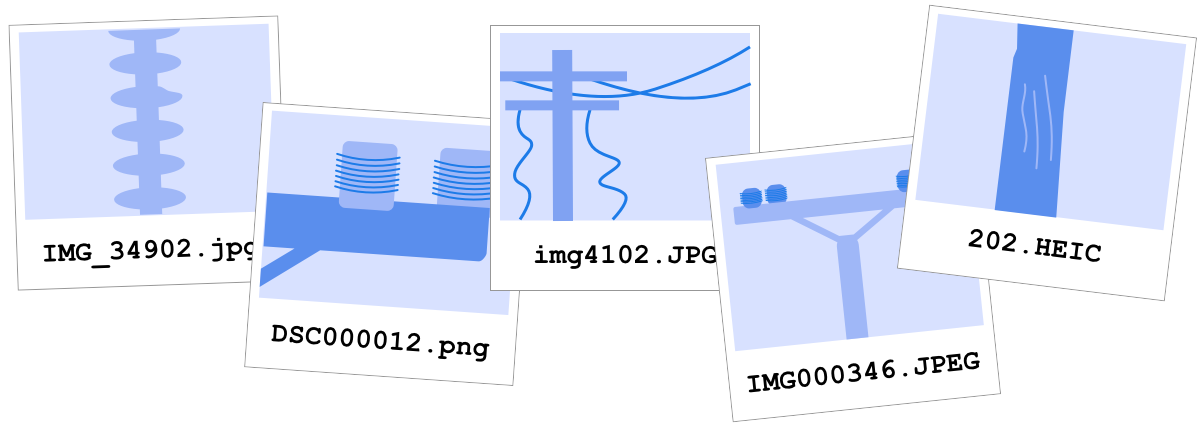
The problem: much of it is buried under filenames like IMG_0421.jpg. Months later, no one remembers which image belonged to which asset or what it showed.
When AI finally enters the workflow, those images can’t be used — they have no memory.
What Labeling Means in Practice
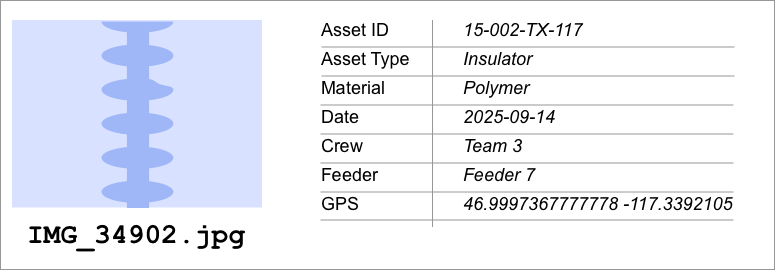
Labeling doesn’t have to be complex or expensive. It’s simply a set of consistent descriptors — metadata that captures who, what, where, and when.
| Metadata | Example | Why It Matters |
|---|---|---|
| Asset ID | 15-002-TX-117 | Links data to a specific Asset |
| Asset Type | Insulator | Enables targeted analytics |
| Material | Polymer | Refines targeted analytics |
| Condition | Torn Shed | Allows trend recognition |
| Date / Crew | 2025-09-14 / Team 3 | Supports traceability |
| GPS / Feeder | 40.45 N / 102.32 W / Feeder 7 | Adds spatial context |
These fields transform a folder of photos into a searchable training dataset.
Why Labeling is Worth it
Utilities don’t inspect assets for fun — they inspect because every pole, every transformer, and every span of line carries responsibility. If you’re already collecting the images, you’re already investing in the data. Labeling ensures that investment compounds over time. When every image is tied to an asset, a condition, and a timestamp, your inspection archive becomes more than a record — it becomes an evolving operational model of your network.
That’s what enables AI-driven capabilities later, such as:
- vegetation encroachment detection,
- pole degradation scoring,
- automated work-order generation.
Failing to label doesn’t save time; it simply postpones work you’ll have to redo later. By labeling now — as part of the normal inspection process — you preserve a complete, reusable history of your infrastructure that grows in value with every inspection cycle.
Lessons From Other Industries
- Transportation: European rail operators labeled defect images early, enabling automated crack detection.
- Telecom: Tower companies labeled corrosion and obstruction photos to automate structural assessments.
- Wind Energy: Turbine manufacturers labeled blade-damage imagery early and now perform near-real-time fault detection.
Transportation
Major rail operators and research programs have advanced automated inspection systems built on structured and labeled data captured over time. In the U.K., Network Rail⁶ documents how measurement trains and track-recording vehicles continuously collect large volumes of visual and sensor data that must be processed into meaningful information to support maintenance decisions. While the report itself focuses on resilience and monitoring, it clearly reflects a broader industry shift: inspection systems now generate far more data than humans can manually review, driving the need for algorithmic and AI-assisted interpretation.
Across continental Europe, the International Union of Railways (UIC)⁷ and Europe’s Rail initiatives describe how operators such as Swiss Federal Railways (SBB) and Austrian Federal Railways (ÖBB) are piloting AI-based analysis of track and infrastructure imagery. These efforts rely on establishing consistent reference datasets and labeled inspection workflows before automation becomes viable.
Academic literature confirms this pattern. A systematic 2022 review of AI applications in railway systems⁸ shows that computer vision for maintenance and inspection is one of the most active research areas, and that model performance depends heavily on the availability of annotated datasets capturing both defects and normal operating conditions.
⁶ Extreme Heat Task Force Engineering Report (Network Rail)
⁷ UIC — Artificial Intelligence in Rail (AIST)
⁸ A literature review of Artificial Intelligence applications in railway systems
Telecom/Towers
Telecommunications infrastructure owners faced a similar challenge earlier: how to inspect thousands of distributed, vertical assets safely, consistently, and at scale. As tower inspections moved from rope access to drones, operators and vendors began capturing large volumes of imagery that quickly exceeded manual review capacity.
Ericsson⁹ describes how AI and computer vision are increasingly used to analyze tower imagery, replacing hazardous climbs and enabling proactive identification of issues such as corrosion, misalignment, or obstruction. These systems are trained on labeled historical images collected during routine inspections, allowing models to learn what “normal” and “abnormal” conditions look like.
Practical case studies support this approach. A corrosion-detection project for overhead-line and tower structures¹⁰ demonstrates how labeled drone imagery can be used to automatically identify corrosion patterns on steelwork at scale. Complementing this, peer-reviewed research¹¹ shows that ensemble deep-learning models trained on annotated tower images can reliably detect structural corrosion, but only when sufficient labeled examples are available.
As with rail, early inspection programs that focused on consistent data capture and labeling laid the groundwork for today’s automated assessments.
⁹ AI in telecom: Past, present and future
¹⁰ Large Scale Corrosion Detection for Overhead Lines
Wind Energy
The wind-energy sector provides one of the clearest examples of how disciplined data labeling enables rapid AI adoption. Wind-turbine blades must be inspected regularly, and early inspection programs generated vast archives of high-resolution imagery documenting erosion, cracks, and lightning damage.
Siemens Gamesa reports that machine-learning systems trained on labeled blade imagery have reduced inspection times by up to 75 percent¹², transforming what was once a manual, time-consuming process into a largely automated one. Similarly, Ørsted¹³ deployed automated drone-based inspection systems capable of inspecting 80-meter blades, relying on computer vision models trained on annotated defect images.
To address trust and verification, DNV¹⁴ launched research programs focused on automated validation of AI-based inspection results, underscoring the industry’s recognition that reliable automation depends on well-curated reference data. Academic reviews of blade-damage detection methods¹⁵ further reinforce this conclusion: high-quality labeled imagery is the foundational requirement for accurate defect detection and condition monitoring.
¹³ The future is here: automated drone robots inspect massive 80m wind turbine blades
Each of these sectors learned the same lesson: the earlier you label, the sooner you benefit.
Practical First Steps for Utilities
These steps don’t require new technology or AI expertise — they simply ensure that inspection data remains usable beyond the immediate job.
Capture and preserve geospatial context
Ensure inspection images are geo-tagged (GPS coordinates and, where possible, altitude and orientation). Spatial context allows images to be reliably associated with assets later — even when filenames, folders, or vendors change.
Add simple, consistent metadata fields
A small, agreed set of metadata — such as asset identifier, inspection date, asset type, condition category, and inspection method — provides enough structure to make images searchable, comparable, and reusable.
Link images to assets, not folders
Images should be associated with asset records (for example via GIS, asset registries, or inspection IDs), rather than relying on directory structures or filenames that are brittle and vendor-specific.
Centralize inspection data with long-term accessibility in mind
Store inspection images and metadata in a system designed for long-term retrieval, auditability, and cross-year comparison — so historical inspections remain usable as crews, contractors, and tools change.
Use and align with emerging industry conventions
Where standards, taxonomies, or common data models are emerging — whether through industry bodies, utilities, or regulators — align with them early. Even partial alignment improves interoperability and reduces future translation effort.
None of these steps require AI or new tools. They simply ensure that the data you’re already collecting can still be learned from — by people today, and by machines later.
The Broader Payoff
Labeling improves daily operations now:
- Searchability: Find past inspections instantly.
- Consistency: Eliminate duplicate site visits.
- Transparency: Prove compliance to regulators.
- Benchmarking: Compare performance across feeders or territories.
Even if your organization isn’t ready to deploy AI models, labeling data today ensures you won’t lose years of valuable operational insight. You’re already paying for inspections: a few extra minutes spent labeling can multiply that investment later.
AI is the long-term reward; operational efficiency is the immediate one.
You’re already paying for inspections: a few extra minutes spent labeling can multiply that investment later.
Why Smaller Utilities Can Move Faster
U.S. co-ops and municipal utilities often have an advantage that larger organizations don’t: fewer layers, tighter feedback loops, and closer proximity between field work and decision-making.
That makes it easier to introduce practical data discipline — such as consistent labeling and asset linkage — without multi-year transformation programs.
By putting these foundations in place now, smaller utilities can position themselves to adopt advanced analytics and AI on their own terms, rather than reacting later under time pressure.
A Simple Truth
AI success isn’t determined by algorithms — it’s determined by data quality. And data quality begins with one simple act: labeling what you see. Every unlabeled photo is a forgotten lesson. Every labeled one is a building block for a smarter, safer grid. Utilities that understand this today won’t just catch up with AI tomorrow — they’ll lead it.
This is only the beginning. In the next article, From Photos to Knowledge, we’ll explore how to structure the data you already have so it can serve as the foundation for future AI initiatives.
In this article, I focused on why inspection data — especially labeled images — matters so much for the future of AI in utilities. The next step is understanding how that data should be structured so it can actually be reused.
In Article 2, From Photos to Knowledge, I’ll look at what turns a collection of inspection images into a durable, searchable, and analysis-ready dataset. I’ll explore practical questions utilities face every day: how images should be linked to assets, what metadata really matters, and why folders and filenames alone are not enough when inspections span years and crews.
The goal isn’t to introduce new technology — it’s to make sure the data you’re already collecting can still teach you something tomorrow.
Michael V. Kay
Chief AI Officer
Michael Kay brings a strategic approach to leveraging AI for critical infrastructure, drawing on a background in implementing innovative tech within emergency and crisis management. His expertise lies in aligning AI strategies with business goals to drive innovation, efficiency, and measurable outcomes.